Property Tax Reform & Its Impact on Winter Springs

Property Tax Reform & Its Impact on Winter Springs

Property Tax Reform: Protecting Winter Springs While Pursuing Responsible Relief

As a homeowner, small business owner, and City Commissioner, I understand firsthand the financial pressures many Winter Springs families are facing. Rising home values, increasing insurance premiums, and the overall cost of living have made affordability a real concern for residents across our community. That’s why conversations around property tax relief coming out of Tallahassee matter and why they must be approached thoughtfully and responsibly.

Several property tax reform proposals are currently being discussed at the state level. While these proposals aim to provide relief to homeowners, particularly seniors and families struggling with rising costs, it is critical to understand how these changes could impact local communities like Winter Springs.

Property taxes are not an abstract line item, they are the primary funding source for essential services residents rely on every day. In Seminole County, property taxes fund the majority of public safety operations, including police, fire rescue, emergency response, road maintenance, and critical infrastructure. Any significant reduction in this revenue, without a clear and sustainable replacement, risks shifting costs elsewhere or reducing services that protect our quality of life.

I support targeted, transparent, and fiscally responsible tax relief. Helping seniors remain in their homes, easing financial strain on families, and addressing affordability are worthy goals. However, one-size-fits-all solutions crafted in Tallahassee without meaningful local input can create unintended consequences at the city level, consequences that residents ultimately feel through reduced services, deferred maintenance, or higher fees.

As a local elected official, my role is to advocate for balance. We can pursue smart tax relief while still protecting public safety, maintaining infrastructure, and ensuring our city remains financially stable. That means working collaboratively with state leaders, not imposing unfunded mandates on cities and counties that are already managing growth, infrastructure needs, and environmental stewardship.

Winter Springs deserves policies that are both compassionate and practical. I will continue to advocate for solutions that respect taxpayers while safeguarding the services that keep our neighborhoods safe, our roads maintained, and our community strong, today and for generations to come.

Together, we can protect Winter Springs by making thoughtful decisions that balance affordability, safety, and long-term sustainability.

Victoria K. Bruce

Winter Springs City Commissioner, District 2

Florida Property Tax Proposals: What They Could Mean for Winter Springs

Florida Property Tax Proposals: What They Could Mean for Winter Springs

Several property tax proposals are currently moving through the Florida Legislature that, if passed, would significantly impact how cities like Winter Springs fund essential services. While these bills are being presented as homeowner tax relief, many local leaders and associations warn that they could create serious long-term financial challenges for municipalities across the state.

As your Commissioner, I believe it’s critical to understand what’s being proposed—and what it could mean for our community.

Overview of the Proposals

Out of eight proposed constitutional amendments relating to property taxes, four have advanced to their next committee. Here’s a summary of each:

HJR 211 – Save Our Homes Portability Expansion

This measure would allow homeowners to transfer the full value of their Save Our Homes tax benefit when moving to a new home, including when downsizing.

Key concern:

Cities heavily reliant on property tax revenue could face service cuts. One vice mayor noted their city could not maintain road maintenance, emergency services, or police protection if this passed.

HJR 209 – Second Homestead Exemption for Comprehensive Insurance

This would provide an additional $200,000 exemption for homeowners maintaining comprehensive insurance coverage.

Key concerns:

  • No definition of “comprehensive” is included in the bill
  • No protection for seniors unable to afford high insurance premiums
  • Unclear outcomes for residents dropped by insurers mid-year

HJR 205 – Elimination of Non-School Property Taxes for Seniors 65+

This proposal removes non-school property taxes for anyone 65 or older.

Key concerns:

  • No income or residency requirement means even new, wealthy residents would qualify
  • Estimated $5.1 billion loss in the first year alone, putting senior services at risk

HJR 201 – Full Elimination of Non-School Homestead Property Taxes

This is the most sweeping bill, aiming to eliminate all non-school property taxes on homesteads statewide.

Key concerns:

  • Projected $14 billion immediate revenue loss
  • Cities would still be required to maintain police budgets, meaning drastic cuts to other services or increased fees

What Local Leaders Are Saying

Our city lobbyist, Andrew Kalel, attended the recent House State Affairs Committee and the earlier Select Committee on Property Taxes. In his report to city staff and commissioners, he noted the broad concern among local government advocates:

“These proposals simply rearrange the furniture in how things are actually funded.” — League of Cities

There was significant testimony warning that:

  • These bills do not protect funding for fire departments, EMS, or other public safety needs
  • Local governments could face higher interest rates for borrowing, due to financial instability
  • Residents would likely see fee increases and service cuts to make up for lost tax revenue

In a particularly candid moment, the Committee Chair acknowledged that some municipalities may not survive under the new structure:

“We are asking for some of these municipalities to actually be run like a business… There may be some municipalities that don’t exist in five years.”

What This Means for Winter Springs

Like many Florida cities, Winter Springs depends on property tax revenue to maintain the quality of life our residents expect. This includes:

  • Clean, safe drinking water
  • Road maintenance and stormwater systems
  • Public safety and law enforcement
  • Fire and EMS services
  • Parks, sports programs, and family-friendly community events

While responsible budgeting is always a priority, these proposed constitutional amendments would dramatically reduce local funding without offering alternative revenue sources—forcing cities to do more with far less.

Next Steps and How to Stay Informed

I encourage every resident to take the time to understand these proposals and their potential consequences. These bills are still under consideration, and your voice matters.

You can watch the recent committee meetings here:

I will continue monitoring this legislation closely and will keep you informed as it develops. As always, I welcome your questions and feedback as we work together to protect the services and values that make Winter Springs a wonderful place to call home.

With appreciation,

Victoria K. Bruce

Winter Springs City Commissioner, District 2

Victoria Bruce Proposes Statewide Tree Mitigation Reform at Florida League of Cities

Victoria Bruce Proposes Statewide Tree Mitigation Reform at Florida League of Cities

I’m proud to announce that I’ve submitted a legislative priority for consideration by the Florida League of Cities Utilities, Natural Resources, and Public Works Policy Committee—and it’s an issue that matters deeply to both our city and the entire state of Florida: Tree Mitigation Fund Reform.

I’m advocating for the creation of statewide rules for how Tree Mitigation Funds are regulated, collected, managed, and spent. 

Specifically, I’ve asked the committee to support:

“The Florida League of Cities SUPPORTS the creation of statewide rules for Tree Mitigation Funds to ensure transparency, consistency, and accountability. A standardized framework would guide the purchase of Tree Mitigation Credits to offset project impacts and require a centralized database to track the receipt and expenditure of funds. This would promote equitable and measurable environmental benefits and replace inconsistent local policies with a uniform, statewide approach.”

In simpler terms: when a tree is destroyed to make way for development, those environmental losses must be offset. But right now, how that happens varies widely across Florida. In some cities, mitigation funds are collected with no clear accountability for how, when, or even if the money is used to replace the lost environmental value.

Like all Florida communities, we’re facing rapid growth, aging infrastructure, and mounting pressure on our natural resources. We must ensure that the tools we use to protect the environment actually work, and that means reforming the way tree mitigation funds are handled.

My professional background in environmental restoration and wetland mitigation banking has given me a front-row seat to the gaps in our current system. 

I’ve seen how inconsistent local rules can result in:

  • Code language varies significantly from each city and county. 
  • No measurable environmental restoration accountability (Funds being utilized for Maintenance/Enhancement and not on Replacing trees)  
  • Public confusion or distrust about where the money goes

What Would Change:

Under this proposal, we’d see the creation of:

  • Statewide guidelines for tree mitigation practices
  • A centralized database that shows how much money is collected and how it’s spent
  • Clear metrics to ensure that any lost tree canopy is replaced with equal or better ecological value

This approach would increase transparency for residents, create more consistency for developers, and—most importantly—ensure that our environment sees real benefit from every dollar spent.

I’ll be presenting this priority at the September 26th meeting in Orlando, and I’m committed to making your voice and values—heard. 

As a fiscally responsible, environmentally focused Commissioner, I believe we can have smart growth and real accountability when we lead with both clarity and conviction.

TLBD Assessment Increase: Is Now the Right Time?

TLBD Assessment Increase: Is Now the Right Time?

On Tuesday, September 9, 2025, the Winter Springs City Commission will consider Resolution 2025-16, which proposes to increase the Tuscawilla Lighting and Beautification District (TLBD) annual assessment from $128 to $255.20 per household.

This nearly 100% increase is intended to fund a broad set of beautification projects totaling $1.83 million, including landscaping, monument restoration, fountain renovation, and street signage.

While these improvements may be worthwhile over time, the core question remains: Is this the right time—and the right approach—to move forward with such a significant financial request from residents?

Reviewing the Scope of the Plan

According to TLBD documentation, the following projects are included in the proposed $1.83 million plan:

Median Landscaping – $1,104,000

  • Renovation of 23 medians on Winter Springs Boulevard
  • Estimated cost: $48,000 per median

Monument Restoration – $500,000

  • Tuscora Median and Monuments: $155,000
  • Trotwood: $28,000
  • East Winter Springs Blvd: $63,000
  • Seneca Blvd: $15,000
  • Shetland: $8,000
  • Deer Run: $6,000
  • West Winter Springs Blvd (Tuskawilla Rd): $225,000

Decorative Street Signs – $50,000

  • Sandblasting, priming, and painting of 125 poles
  • Estimated at $400 per pole

Fountain Maintenance & Renovation – $176,000

  • Monthly maintenance: $1,300
  • Full renovation of the North Fountain

Total Proposed Investment: $1,830,000

Fiscal Responsibility Means Clarity and Balance

Beautification is important. The value of well-maintained medians, entryways, and signage is not in question. But when asking residents for a 99% increase in assessments, the City has a responsibility to be clear:

  • What must be done now, and what can be phased?
  • Are we conflating projected future needs with current-year spending?
  • Have we explored alternative funding or multi-year planning instead of frontloading all expenses into a single year?

Reviewing the Budget Numbers

TLBD documents show a projected year-end fund balance of approximately $57,000—not zero. While tight, this does not reflect an emergency. In fact, much of the reported budget “shortfall” stems from capital improvement items budgeted but not yet spent, including over $260,000 in projected construction and equipment.

A key concern is that the proposed rate increase may be based on aspirational spending plans, not confirmed obligations. That distinction matters—especially when we are asking homeowners to pay significantly more.

Where Does the Money Go?

To help residents better understand the spending plan, the TLBD committee has prepared a presentation that outlines the full proposal, including costs by project category.

Public Input is Essential

As a Commissioner, I support investing in our community. But I also believe in asking tough questions and ensuring that spending matches real priorities.

If you are a resident of the TLBD, I encourage you to attend the upcoming special meeting and share your thoughts.

Meeting Details:

Date: Tuesday, September 9, 2025

Time: 5:30 PM

Location: Winter Springs City Hall

To review the full agenda and documents related to Resolution 2025-16:

Final Thoughts

The future of Tuscawilla should be planned with vision, care, and balance. Let’s make improvements the right way—by clearly understanding the need, confirming the timing, and ensuring full transparency.

Let’s ask the right questions—before asking our neighbors to pay more.

— Victoria Bruce

City Commissioner, District 2

Winter Springs, Florida

Where Your Property Taxes Go & Why It Matters for Winter Springs

Where Your Property Taxes Go & Why It Matters for Winter Springs

Where Your Property Taxes Go — And Why It Matters for Winter Springs’ Future

As your City Commissioner, I believe in transparency and accountability — especially when it comes to your tax dollars. That’s why I’m breaking down how Winter Springs property taxes are allocated and why it matters for our city’s future. With more families and neighbors asking, “Where is all this money going?” and “Why are services stretched thin?” — I wanted to take a moment to share what the numbers actually show.

First: Where Do Your Property Taxes Actually Go?

Many residents are surprised to learn that only a small portion of your property tax bill stays in Winter Springs.

For every $1 you pay in property taxes:

  • 48.61¢ goes to Seminole County
  • 33.59¢ goes to the School Board
  • Only 16.67¢ stays with Winter Springs
  • 1.14¢ goes to Special Districts

That means our city only keeps about 17 cents per dollar to provide essential services like police, parks, wastewater infrastructure, and drinking water improvements.

With so much of your tax dollar going elsewhere, every decision we make locally has to be fiscally responsible and strategically prioritized.

Public Safety Costs Are Rising

In 2023, Winter Springs collected $7.39 million in property tax revenue — yet we spent $8.76 million on law enforcement alone.

This gap doesn’t even include costs for fire protection, infrastructure, or community programs.

Public safety is a top priority. But we must face the reality: the cost to provide services is outpacing our current revenue.

The Impact of Tax Caps and Homestead Protections

Many homeowners benefit from Save Our Homes and other exemptions — and I fully support these protections.

However, they also limit how much taxable value can increase each year, even as home values climb. This means the city’s revenue doesn’t grow as fast as the market, which puts pressure on our ability to fund long-term needs.

A Word on Development — And Why the Conversation Matters

Over the past year, many residents have voiced concern about new development — and rightfully so. Growth should never happen at the expense of our environment, infrastructure, or quality of life.

But here’s what the data shows:

  • Winter Springs is spending more than it collects in property taxes.
  • Public safety and infrastructure needs are growing.
  • Our city receives only 16.67% of every property tax dollar.
  • Local business tax revenue is just 1.28% of unrestricted revenues.

What does this mean? We need to plan wisely. This isn’t about pushing for more development — it’s about making sure we have the resources to maintain and improve the services our residents expect.

I believe in smart growth, not sprawl. Growth that fits the character of Winter Springs — and ensures that those who move here contribute to the cost of the services they will use.

Our city deserves thoughtful planning — and that means understanding the numbers, setting clear expectations, and being proactive, not reactive.

Let’s Keep Winter Springs Financially Sound

71% of cities across Florida are keeping millage rates flat or lower than 2020. Many are making difficult decisions — and we must do the same.

As your Commissioner, I’m committed to:

  • Protecting your tax dollars
  • Prioritizing public safety and clean water
  • Making smart decisions that protect Winter Springs now — and for future generations

Want to Dive Into the Full Report?

For those who want to see the full picture, we’ve embedded the complete Property Tax Data Packet below.

Flip through the full report embedded below.

Winter Springs is a beautiful community — and it’s my honor to serve you. My focus is to protect what makes this city special, while also ensuring we have the resources to support our families, our safety, and our future.

Let’s keep the conversation going. If you have thoughts, questions, or concerns, please reach out. I’m always here to listen and work with you.

Why the Penny Sales Tax Renewal is Essential for Seminole County’s Future

Why the Penny Sales Tax Renewal is Essential for Seminole County’s Future

As your City Commissioner for Winter Springs, I am committed to ensuring our community continues to thrive. One of the key ways we can achieve that is by renewing the One Cent Infrastructure Sales Tax, also known as the Penny Sales Tax, this November.

What is the Penny Sales Tax?

For over 30 years, this tax has been a cornerstone of growth and development in Seminole County. It’s not a new tax, but a continuation of a highly successful initiative that generates funding for essential infrastructure projects. From improving roads and sidewalks to enhancing water quality and supporting school construction, the Penny Sales Tax has already brought in over $2 billion to strengthen our communities.

Why Does This Matter?

The revenue generated from the Penny Sales Tax is crucial for maintaining and upgrading our infrastructure. Here in Winter Springs and throughout Seminole County, we’ve seen the positive effects of this funding, such as:

  1. Road Improvements: Safer, more efficient roads with added turn lanes, repaved surfaces, and upgraded traffic signals.
  2. Pedestrian and Bicycle Infrastructure: More trails, sidewalks, and bike lanes that connect our community and encourage a healthy, active lifestyle.
  3. Environmental Conservation: Support for stormwater management and environmental restoration projects that protect our natural resources.
  4. Public Safety Enhancements: Investments in new safety vehicles, emergency services, and equipment to keep our neighborhoods safe.

These projects improve our quality of life, help keep property taxes low, and ensure that Seminole County remains a place where people want to live, work, and raise their families.

The Power of the Penny

One of the most compelling reasons to support the Penny Sales Tax is that a significant portion—up to 30%—of the revenue comes from non-residents. That means visitors and out-of-county shoppers contribute to the cost of improving our local infrastructure, easing the burden on our residents. This is a smart and efficient way to fund the improvements we all rely on without increasing taxes for Seminole County homeowners.

Why Renewal is Important

Without this funding, many essential projects would be delayed or potentially canceled. We would have to rely on state and federal funding, which can take years to secure. By renewing the Penny Sales Tax, we maintain control over how we fund and prioritize local projects that directly impact our daily lives.

I’ve always believed in finding balanced solutions that promote both economic growth and environmental preservation. The Penny Sales Tax does exactly that. It allows us to grow responsibly while protecting the natural beauty and resources that make Winter Springs and Seminole County such special places.

Join Me in Supporting the Renewal

This November, I urge you to join me in voting YES for the renewal of the Penny Sales Tax. Let’s continue investing in our community’s future by ensuring we have the resources to build and maintain the infrastructure that keeps Winter Springs and all of Seminole County thriving.

To learn more about the Penny Sales Tax and how it benefits our community, I invite you to watch this informative video from former County Commissioner John Horan:

Together, we can make sure Winter Springs remains a beautiful, safe, and vibrant community for generations to come.

Warm regards,

Victoria Bruce

Winter Springs City Commissioner, District 2

APPROVAL OF ASSESSMENT ROLLS

APPROVAL OF ASSESSMENT ROLLS

Pursuant to Section 197.3632, Florida Statutes, each of the following assessment rolls shall be certified to the Seminole County

Tax Collector prior to September 15, 2023, along with any necessary changes subsequent to the date hereof permitted under Sections 3.12 and 4.12 of the Ordinance and the Uniform Assessment Collection Act.

A. Tuscawilla Improvement Area. The non-ad valorem assessment roll on file with the City Clerk for the Tuscawilla Improvement Area is hereby approved, such roll setting the annual rate of $36.00 per Equivalent Residential Unit (reflecting no change compared to the prior year amount and $7.00 less than the maximum rate of $43.00 previously authorized by the City.

B. Tuscawilla Maintenance Assessment Area. The non-ad valorem assessment roll on file with the City Clerk for the Tuscawilla Maintenance Assessment Area is hereby approved, such roll setting the annual rate of $128.00 per Equivalent Residential Unit (reflecting an increase of $8.00 compared to the prior year amount and being equal to the maximum rate of $128.00 previously authorized by the City).

C. Oak Forest Assessment Area (Maintenance). The non-ad valorem assessment roll on file with the City Clerk for the Oak Forest Assessment Area (Maintenance) is hereby approved, such roll setting the annual rate of $60.00 per Benefit Unit (reflecting no change from the prior year amount and $3.00 less than the maximum rate of $63.00 previously authorized by the City).

D. Tuscawilla Phase III Assessment Area (Capital). The non-ad valorem assessment roll on file with the City Clerk for the Tuscawilla (Phase III) Assessment Area (Capital) is hereby approved, such roll setting the annual rate of $88.00 per Beneficial Unit (reflecting an increase of $3.00 compared to the prior year amount and being equal to the maximum rate of $88.00 previously authorized by the City).

E. Tuscawilla Phase III Assessment Area (Maintenance). The non-ad valorem assessment roll on file with the City Clerk for the Tuscawilla (Phase III) Assessment Area (Maintenance) is hereby approved, such roll setting the annual rate of $87.00 per Benefit Unit (reflecting no change compared to the prior year amount and compared to the maximum rate of $87.00 previously authorized by the City).
Investing in Infrastructure: How Winter Springs is Spending the One Cent Infrastructure Sales Tax

Investing in Infrastructure: How Winter Springs is Spending the One Cent Infrastructure Sales Tax

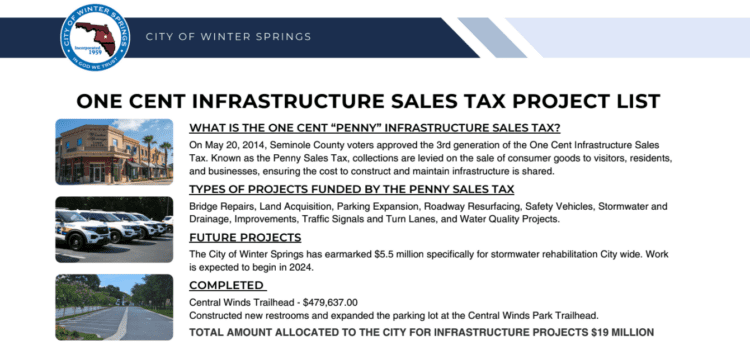
The document below outlines the spending summary for various projects in the City of Winter Springs, financed by the One Cent Infrastructure Sales Tax approved by Seminole County voters in 2014. This tax, applied to the sale of consumer goods to visitors, residents, and businesses, supports construction and maintenance of infrastructure.

The major expenditure areas include:

Land Acquisition: $720,363 was spent on two land parcels for future park expansion at Central Winds Park and Torcaso Park.

Winter Springs Town Center Improvements: $475,000 was spent on enhancing and expanding parking.

Road Resurfacing and Safety Improvements: $3,838,924 was spent on safety enhancements along Winter Springs Boulevard and resurfacing several roadways.

Bridge Repairs: $611,957 was spent on a study to identify future bridge repair needs and repair work after Hurricane Ian. An additional $2.5 million has been allocated for future repairs.

Safety and Utility Vehicles: $2,884,000 was spent on acquiring 16 new vehicles for the police department and equipment for the Utilities department.

Winter Springs Utilities: $2,000,000 was spent on critical capital repairs to the water treatment plant and waste water treatment facility.

Furthermore, $5.5 million has been earmarked specifically for stormwater rehabilitation Citywide, with work expected to start in 2024. The total amount allocated for infrastructure projects is $19 million.

Finally, there were also numerous reallocations, amendments, and contingencies outlined for various sub-projects within the city infrastructure.